Harwood ND Pole Barn Builders | Post-Frame Buildings on Red River Bottomland
Post-frame buildings in Harwood and the surrounding townships, on Red River bottomland where spring water is the main design constraint. How high the pad sits matters more than anything else about the building, and it is the one thing that cannot be added once the columns are set. Fargo ND Pole Barn Builders also builds across the rest of Cass County, North Dakota and Clay County, Minnesota.
Get a quote on your building
Tell us the size, the use and where the site is. We will come back with a scope and a price, not a brochure.
Harwood ND Pole Barn Builders
Bottomland north of Fargo, where spring decides the schedule
Harwood sits north of Fargo at an elevation of about 889 feet, on the Red River bottomland. It was founded in 1881 and has grown steadily since the eighties, from around 326 residents in 1980 to 794 at the 2020 census.
The defining fact for building here is water. The Red River flows north, which means the lower reaches thaw last, and spring meltwater in this stretch of the valley has nowhere to go and no fall to take it there. Every building decision in Harwood follows from that.
Local conditions and figures
The elevation figure is worth dwelling on. Harwood sits at about 889 feet. Barnesville, on the glacial beach ridge east of the valley, sits at about 1,030 feet. That 140-foot difference over thirty-odd miles is essentially the entire relief of the Red River Valley, and it explains why nothing drains here without help.
The soil is heavy Lake Agassiz clay throughout, which holds water, has low bearing capacity when saturated, and swells and shrinks seasonally. Isolated footings taken to 60 inches get past the worst of the seasonal movement, and a granular pad breaks the capillary path up into the slab.
One further consideration on bottomland is what happens to the building when the water does arrive. A post-frame structure with its slab floating independently inside copes with an inch or two of water across the floor far better than a building whose slab is tied into continuous foundation walls. That is not a reason to be relaxed about pad height, but it does mean the structural system is working with you rather than against you.
Ring dikes exist for a reason worth understanding
A good number of farmsteads along this stretch of the Red sit inside a low earthen dike, and many more are simply built up above the surrounding field. Those heights were chosen by people who had watched the water, often more than once. When we site a new building on an established yard, working out why the existing buildings sit where they do is the first thing we try to understand, because that information was bought expensively.
Building on bottomland
Four things we do differently here.
- Build the pad higher than you think you need
The extra fill is cheap relative to everything else and it is the one thing you cannot add later. On bottomland we would rather be accused of over-building the pad than under-building it.
- Schedule around the thaw, not the calendar
Between thaw and the ground drying out, this clay will not carry a loaded truck. Planning a spring pour on a Harwood bottomland site is planning to be disappointed.
- Check bearing in every bore
Bottomland soil profiles vary over short distances, and old channel deposits turn up where nobody expects them.
- Keep the column bases out of standing water
Where a site floods periodically, precast concrete column bases or steel brackets that lift the timber above the water line are worth the additional cost.
How we build in Harwood
- Pad raised deliberately
Not nominally. On bottomland the difference between six inches and eighteen inches of pad height is the difference between a dry building and an annual problem.
- Floodplain position established
Cass County Planning administers floodplain matters for jurisdictions outside the NFIP, and it gets checked before siting.
- Spring access planned into the schedule
Saturated clay will not carry ready-mix or material trucks, and that is a scheduling reality rather than an excuse.
- Drainage route taken all the way out
To somewhere the water can actually go, not just to the edge of the pad.
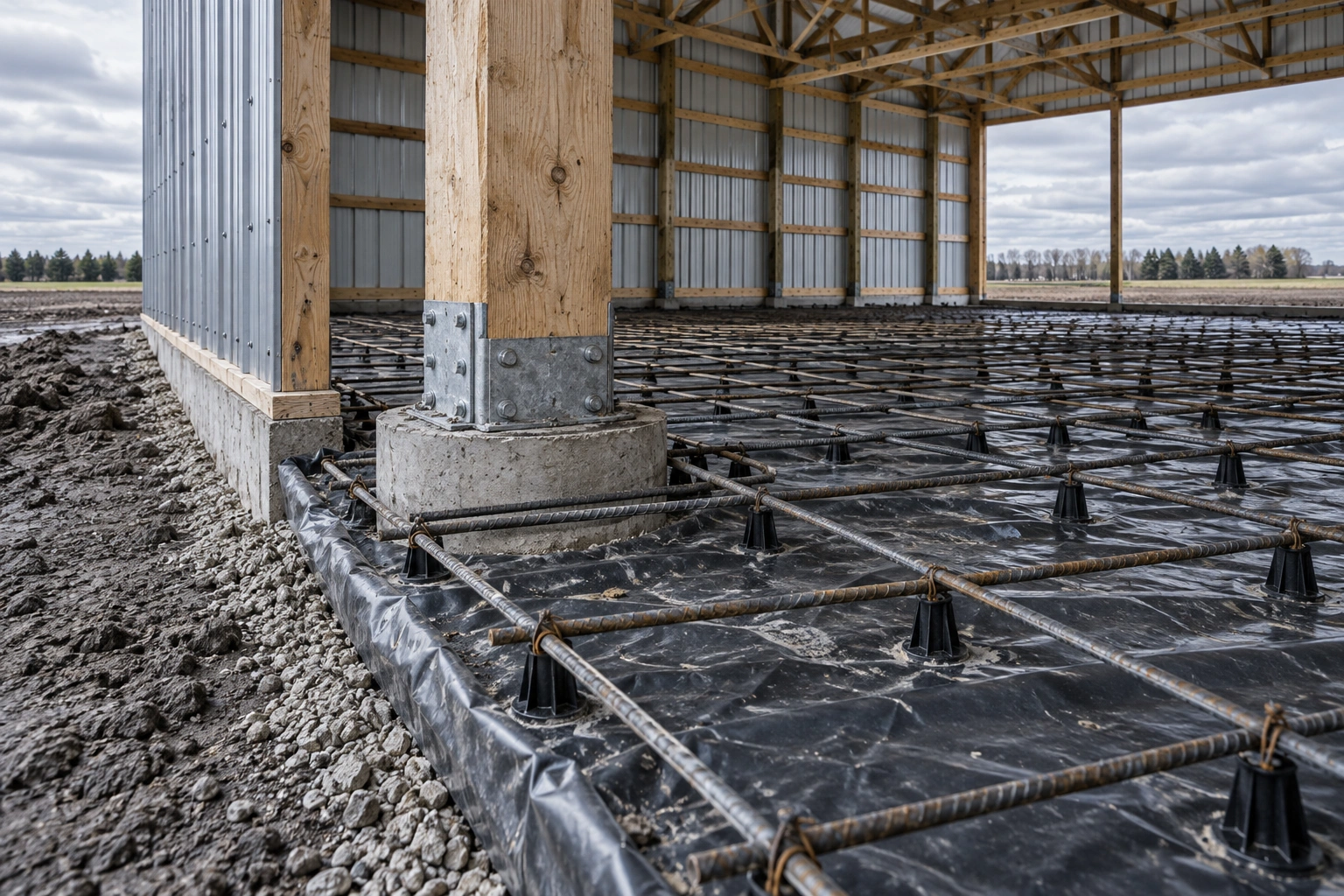
Many farmsteads in this part of the valley sit inside a low earthen ring dike, which is a local response to a very local problem. Even where there is no formal dike, established yards here are usually built up above the surrounding field, and there is normally a reason for the height that was chosen.
When we site a new building on a yard like that, the first thing we do is work out why the existing buildings sit where they do. That knowledge was bought expensively by whoever built them.
How a Harwood build runs
- Step 01Site and water assessment
Existing yard levels, where water sits in spring, and the floodplain position established.
- Step 02Pad design and construction
Fill volume and height set deliberately, placed in compacted lifts with a drainage route out.
- Step 03Foundations
Holes augered to 60 inches, bearing checked in each one, footings placed and columns set.
- Step 04Frame and finish
Structure, roof and cladding, with concrete poured under cover once the building is closed in.
Planning a build on Harwood bottomland
On this ground the scheduling decisions matter as much as the design ones.
- Establish your floodplain position first
Not after the design. Cass County Planning administers floodplain matters for jurisdictions outside the NFIP, and the answer can change where the building goes entirely.
- Tell us where the water sits in April
Every yard here has a low spot and an owner who knows exactly where it is. That knowledge decides pad height more reliably than a level survey taken in August.
- Plan for a summer or autumn build
Saturated bottomland clay will not carry a ready-mix truck. Booking a spring pour on a site like this is booking a delay.
- Consider precast column bases
On a yard that takes water periodically, keeping timber entirely above the flood line costs more up front and removes the decay question for the life of the building.
Questions we get asked in Harwood
Is flooding a problem for building in Harwood?
Spring water is a design consideration on almost every bottomland site here, though that is different from being in a mapped floodplain. We establish the floodplain position first, and then design the pad height and drainage for the site's actual behaviour regardless of what the map says.
How high should the building pad be?
Higher than on most sites. The figure comes from the site levels and where water sits in spring, but on Harwood bottomland we would generally be building up more than we would on higher ground, and we would rather over-do it.
What time of year can you build at Harwood?
Framing can happen most of the year. The constraint is access: saturated clay in spring will not carry ready-mix or material trucks. Late summer and autumn are the reliable windows, and winter is often better than April.
Do I need a permit in Harwood?
It depends on whether the parcel is inside the city or in the surrounding township. Township ordinances govern setbacks in unincorporated areas, and Cass County Planning provides support and handles floodplain administration for jurisdictions outside the NFIP.
Will a post-frame building be stable on this clay?
Yes, and it is better suited to it than most alternatives. Isolated footings to 60 inches reach below the active zone, and the floating slab can move seasonally without dragging the structure with it.
Is a Harwood site visit free?
Yes. On bottomland sites the visit is particularly worth having, because what you know about where water goes in spring is information we cannot get any other way.
Should I build inside the existing ring dike or outside it?
Inside, almost always, if there is room. The dike exists because somebody worked out where the water gets to, and putting a new building outside that line means relying on the pad alone. Where there genuinely is no room inside, the pad has to do the whole job and we would build it higher than we otherwise would.
Does a floodplain determination come before or after the permit?
Before, and ideally before siting rather than before submission. On bottomland north of Fargo the floodplain position can dictate where a building may go and how much fill has to sit under it, which is not something to discover once a layout is costed. Cass County Planning administers floodplain matters for jurisdictions outside the National Flood Insurance Program.
Everything we build in Harwood
Every service here is available at Harwood. What bottomland changes is the pad, the foundation detail and the time of year we can work, rather than the kind of building itself.
- Agricultural Pole Barns
- Horse Barns & Equestrian Buildings
- Machine Sheds & Equipment Storage
- Livestock Barns
- Hay Storage Buildings
- Pole Barn Garages
- RV & Boat Storage Pole Barns
- Pole Barn Workshops
- Commercial Pole Barns
- Hobby Shops & Man Cave Pole Barns
- Pole Barn Construction
- Pole Barn Design & Planning
- Pole Barn Foundation & Concrete Work
- Pole Barn Framing
- Pole Barn Roofing Installation
- Pole Barn Siding Installation
- Pole Barn Electrical Rough-In
- Pole Barn Insulation Installation
- Pole Barn Repair
- Pole Barn Renovation & Additions
- Post-Frame Building Construction
- Insulated Pole Barns
- Pole Barns with Living Quarters (Barndominiums)
- Custom Pole Barn Doors & Windows
- Pole Barn Loft & Second-Story Additions
- Metal Roof Pole Barns
- Wood-Sided Pole Barns
- Pole Barn Ventilation Systems
- Pole Barn Site Prep & Grading
- Pole Barn Snow Load Reinforcement
Building on Harwood bottomland
Tell us where the site is and what it does in spring. That conversation shapes the pad design more than the building does.