Arthur ND Pole Barn Builders | Clear-Span Farm Buildings & Shops
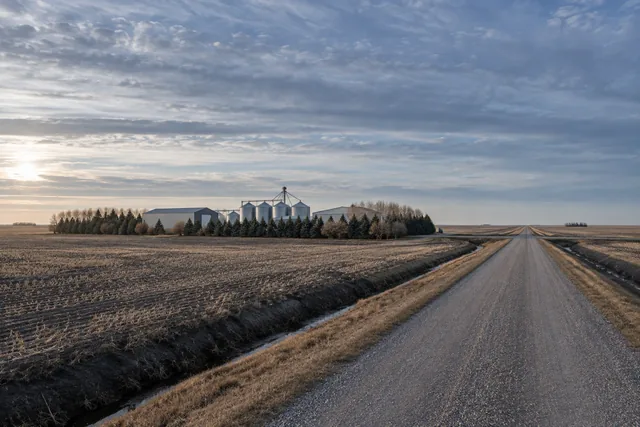
Post-frame farm buildings and shops around Arthur, in the grain country of northern Cass County. Grain country, with buildings scaled to equipment that has grown steadily larger for thirty years and shows no sign of stopping. Fargo ND Pole Barn Builders also builds across the rest of Cass County, North Dakota and Clay County, Minnesota.
Get a quote on your building
Tell us the size, the use and where the site is. We will come back with a scope and a price, not a brochure.
Arthur ND Pole Barn Builders
Grain country, and buildings scaled to it
Arthur sits in northern Cass County with around 328 residents, in an area dominated by grain farming at scale. The buildings that go up around here reflect that: large clear spans, tall eaves, and door openings sized for equipment that has grown steadily larger over the last thirty years.
The design constraints are the same as everywhere in this part of the county: flat ground with no natural drainage, complete wind exposure, and a 40 psf ground snow load that becomes considerably more than that in any drift zone.
Gravel roads, not weather, set the programme
Out here the thing that most often moves a build date is not temperature. Section-line gravel roads carry heavy loads well when they are dry or frozen and poorly in between, and ready-mix trucks and material trailers both need the last mile to hold up. That is why late summer, autumn and deep winter tend to be the reliable windows for northern Cass County work, and why a spring start is the one we most often advise against.
Before a large farm building near Arthur
Four decisions that shape a big agricultural building.
- Fix the clear span from the operation, not the catalogue
Interior columns in a machine building are an obstruction for its entire life. Engineered trusses reach 80 feet and beyond, and the cost of removing the columns is usually worth paying once.
- Take the eave height from the tallest configuration
A raised loader arm, a stacked header cart or an auger in transport can all exceed the machine's spec height. Measure what you actually move.
- Say what is going to be stored
Seed, fertiliser and chemical storage bring containment, ventilation and separation requirements that a machine shed does not. Raising it at design stage is free.
- Consider the drift between buildings
Any new structure beside an existing taller one creates a step, and the drift load in that step can reach several times the balanced figure.
How we build in Arthur
- Clear span sized to the operation
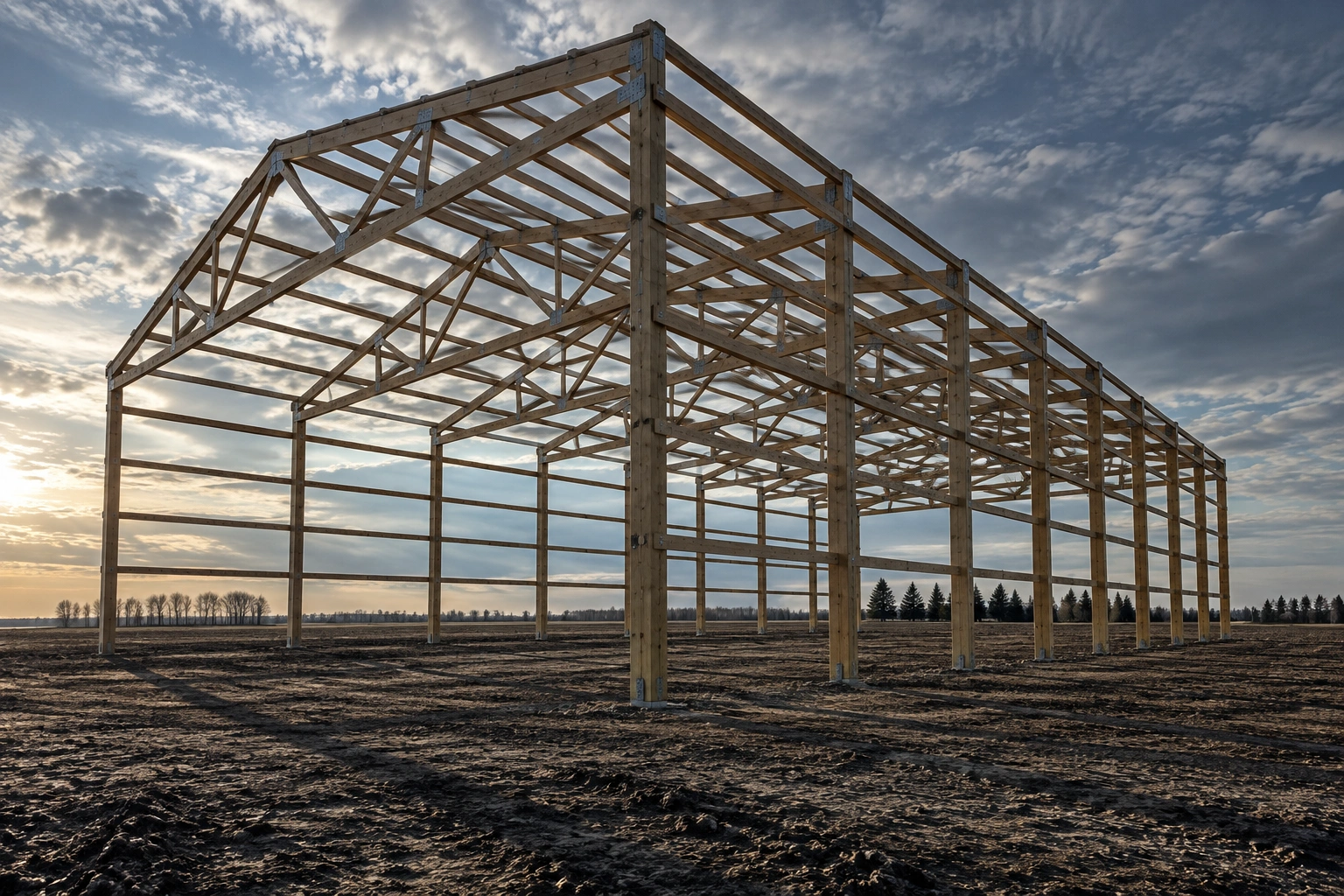
Engineered wood trusses reach 80 feet and beyond, which removes interior columns entirely from the working floor.
- Eave height from the real machine
The tallest configuration you actually move, including anything raised or folded.
- Drift checked on every step
Lean-tos and additions beside taller buildings are where snow accumulates and where failures happen.
- Exposure C wind design
Open country in every direction, with the design pressures that follow.
Grain and input storage buildings have requirements that a machine shed does not. Seed, fertiliser and chemical storage bring containment, ventilation and separation considerations, and in some cases regulatory ones. It is worth raising at design stage rather than discovering afterwards that the building you put up is not suitable for what you want to store in it.
The structural side is straightforward: the same post-frame system, with the wall and floor detailing adapted to what is going inside.
Local conditions and figures
Northern Cass County farmsteads are typically well established with mature shelterbelts, and those shelterbelts are a significant factor in siting. They protect the yard and they concentrate drifting snow in predictable places. A new building sited in a drift zone will collect snow against it every winter for the rest of its life.
Access is the other practical consideration. Section-line gravel roads carry heavy loads well when they are dry and frozen, and considerably less well in spring. Material delivery and ready-mix scheduling both depend on that.
Grain operations also tend to build in sequence rather than all at once, with a shed this year, a shop in three years and bin sites developing alongside. The value of thinking about the whole yard at the start is that each new structure changes the wind and snow behaviour around the existing ones. A yard laid out building by building without that view tends to accumulate drift problems that nobody individually caused.
Large agricultural buildings around Arthur
Four things that decide whether the building works.
- Clear span with nothing in the way
Interior columns in a machine building are an obstruction forever. Clear-span trusses cost more and they remove the problem permanently.
- Door openings sized honestly
The finished clear opening after track and hardware, not the nominal size, checked against the machine in transport position.
- Drift on every roof step
Any addition, lean-to or lower roof beside a taller one collects drift, and the load there can be several times the balanced roof load.
- Pad height and drainage
On flat northern Cass ground, water sits until somebody directs it. The pad and the drainage route are designed, not assumed.
How an Arthur build runs
- Step 01Measure and plan
Equipment measured, spans and door sizes set, orientation checked against drift patterns and shelterbelts.
- Step 02Design to current loads
40 psf ground snow load with drift cases, Exposure C wind, and engineered truss and connection design.
- Step 03Pad and foundations
Raised pad in compacted lifts, footings to 60 inches with bearing verified in each bore.
- Step 04Frame, roof, openings
Structure and roof first for weather protection, then cladding and the door installations.
Questions we get asked in Arthur
How big a building can you put up?
Clear spans of 80 feet and beyond are routine with engineered wood trusses, with length limited only by practicality. What changes at larger spans is truss depth, bracing requirements and column sizes, all of which get designed rather than assumed.
Can you build a fertiliser or seed storage building?
Yes, and it needs raising at design stage because containment, ventilation and separation requirements differ from a machine shed. The structural system is the same; the detailing is not.
What snow load applies around Arthur?
40 psf ground snow load under the North Dakota county table for Cass County, with roof snow calculated from it under ASCE 7. Drift cases are checked separately and can be several times higher in a roof step.
Do you build lean-tos onto existing sheds?
Yes, but we check the drift case first, for both the new roof and the existing one. A lower roof beside a taller wall is the classic drift trap, and it is where most of the failures we see have happened.
How far out do you work?
Northern Cass County is part of our normal area. Distance affects the schedule rather than whether we take the work.
Are quotes free out at Arthur?
Yes. Quotes and site visits cost nothing, and we will measure equipment while we are out there.
Can you work around an existing bin site?
Yes, and the siting question is worth taking seriously. Bins and a new building together change how wind moves through the yard and where snow ends up, sometimes in ways that were not a problem when the bins stood alone. We would walk the yard and look at the existing drift patterns before fixing a position.
Does a fertiliser or chemical store need extra approvals?
It can, and they sit outside the building permit. Storing agricultural chemicals or fertiliser at volume brings containment and environmental requirements that a machine shed does not, and those are administered separately from whoever issues your building permit. Tell us what is going inside at design stage and we will establish what applies before the building is laid out.
Everything we build in Arthur
All of these are available around Arthur, at the scale the grain operations here tend to need them.
- Agricultural Pole Barns
- Horse Barns & Equestrian Buildings
- Machine Sheds & Equipment Storage
- Livestock Barns
- Hay Storage Buildings
- Pole Barn Garages
- RV & Boat Storage Pole Barns
- Pole Barn Workshops
- Commercial Pole Barns
- Hobby Shops & Man Cave Pole Barns
- Pole Barn Construction
- Pole Barn Design & Planning
- Pole Barn Foundation & Concrete Work
- Pole Barn Framing
- Pole Barn Roofing Installation
- Pole Barn Siding Installation
- Pole Barn Electrical Rough-In
- Pole Barn Insulation Installation
- Pole Barn Repair
- Pole Barn Renovation & Additions
- Post-Frame Building Construction
- Insulated Pole Barns
- Pole Barns with Living Quarters (Barndominiums)
- Custom Pole Barn Doors & Windows
- Pole Barn Loft & Second-Story Additions
- Metal Roof Pole Barns
- Wood-Sided Pole Barns
- Pole Barn Ventilation Systems
- Pole Barn Site Prep & Grading
- Pole Barn Snow Load Reinforcement
Farm buildings around Arthur
Tell us the span you need and what goes through the doors. We will design it around the machinery.